Welder trade involves joining metal parts using various welding processes such as arc welding, gas welding, and MIG/TIG welding. Welders are responsible for preparing surfaces, selecting appropriate welding techniques, and ensuring strong and durable joints. They work in industries like construction, shipbuilding, automotive, and fabrication. This trade requires knowledge of welding safety, equipment handling, and material properties. Welders also perform cutting and repair work on metal structures. Skilled welders are in high demand across industries and can find employment in manufacturing units, infrastructure projects, and maintenance services.
A Welding Wire Feeder is a workshop machine used to feed a continuous welding wire electrode into the welding arc at a controlled speed. It is commonly used in MIG and flux-cored arc welding processes. The feeder ensures a steady and consistent supply of wire, which helps maintain stable arc conditions and produces uniform weld quality.
Flint Spark Lighter
A Flint Spark Lighter is a hand tool used to safely ignite gas in welding and cutting operations. It produces a spark by striking a flint against a rough surface, which ignites the gas coming from a welding torch. This tool eliminates the need for matches or lighters, making it safer for industrial use.
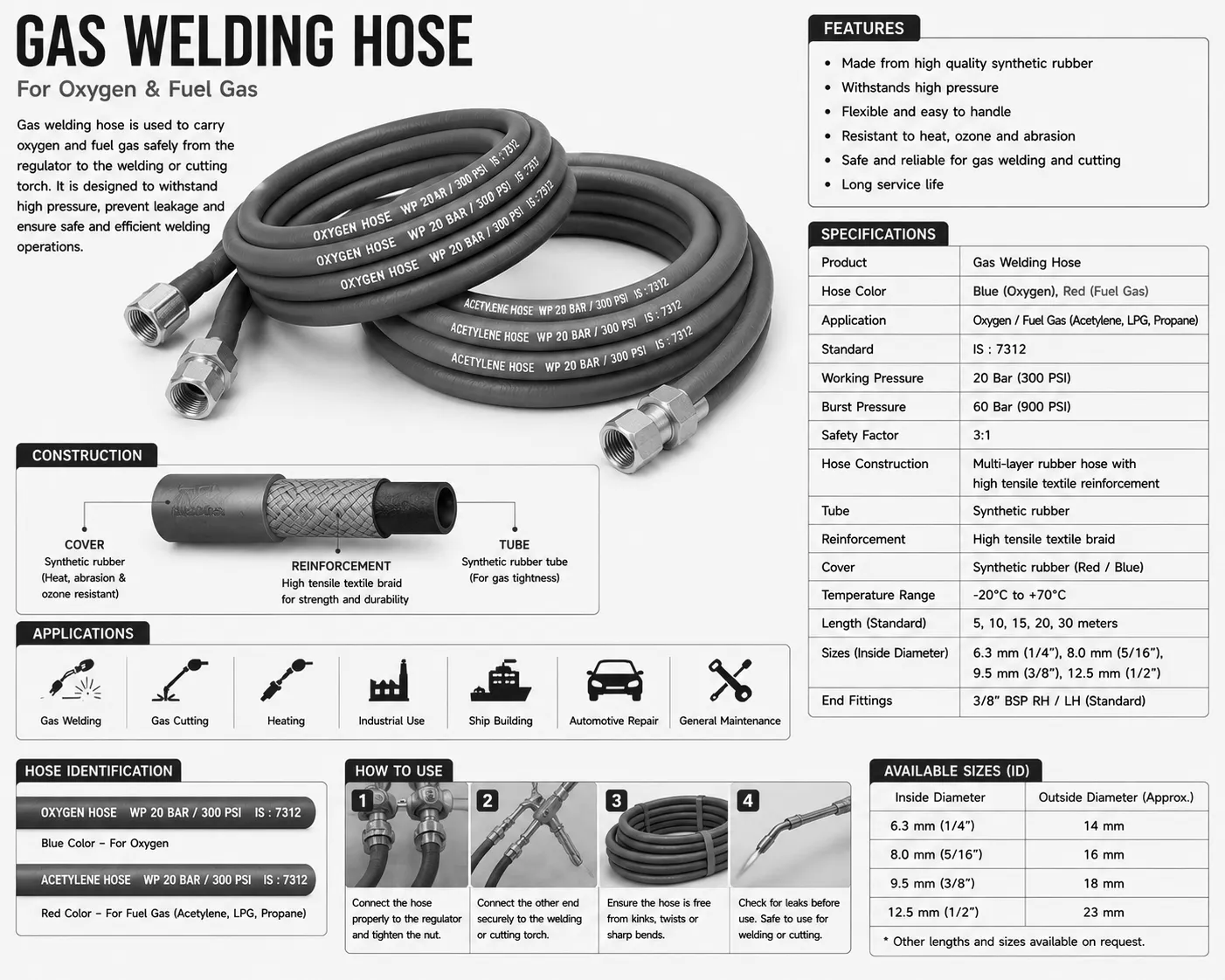
Gas Welding Hose
A Gas Welding Hose is a flexible tube used to carry fuel gases such as acetylene and oxygen from gas cylinders to welding or cutting equipment. It is designed to withstand high pressure and is color-coded (usually red for acetylene and blue/green for oxygen) for safety and easy identification. These hoses are essential components in gas welding and cutting operations.
Oxy Acetylene Cutting Torch
An Oxy Acetylene Cutting Torch is a hand tool used for cutting metals by using a high-temperature flame produced from the combustion of oxygen and acetylene gas. The flame heats the metal to its ignition temperature, and a stream of pure oxygen is then used to oxidize and cut through the metal. It is widely used in fabrication, repair, and metal cutting operations.
MIG Welding Machine
A MIG Welding Machine (Metal Inert Gas Welding Machine) is a welding machine used to join metals by feeding a continuous consumable wire electrode through a welding gun, along with a shielding gas to protect the weld pool from contamination. It produces smooth, strong, and clean welds with high efficiency and is widely used in fabrication, automotive, and industrial applications.
TIG Welding Machine
A TIG Welding Machine (Tungsten Inert Gas Welding Machine) is a welding machine used to join metals using a non-consumable tungsten electrode and an inert gas shield such as argon. It produces a clean, precise, and high-quality weld without spatter. TIG welding is widely used for welding thin sections of stainless steel, aluminum, and other non-ferrous metals.
Seam Welding Machine
A Seam Welding Machine is a type of resistance welding machine used to produce continuous welds along a joint. It uses rotating wheel electrodes that apply pressure and electric current to join metal sheets, forming a leak-proof and strong seam. This machine is widely used in manufacturing industries for welding tanks, pipes, and containers.
Spot Welding Machine
A Spot Welding Machine is a machine tool used to join metal sheets by applying heat and pressure at specific points. It works on the principle of resistance welding, where electric current passes through the metal surfaces and generates heat at the contact point, forming a weld. This machine is widely used in automotive, fabrication, and sheet metal industries for fast and efficient joining.
Gas Welding Torch
Welding Helmet
A Welding Helmet is a protective safety equipment used by welders to protect the eyes, face, and neck from harmful radiation, sparks, and heat generated during welding operations. It is equipped with a darkened filter lens that shields the eyes from intense light and ultraviolet/infrared rays. Modern helmets may include auto-darkening features for better visibility and convenience.