

Angle Gauge
Description
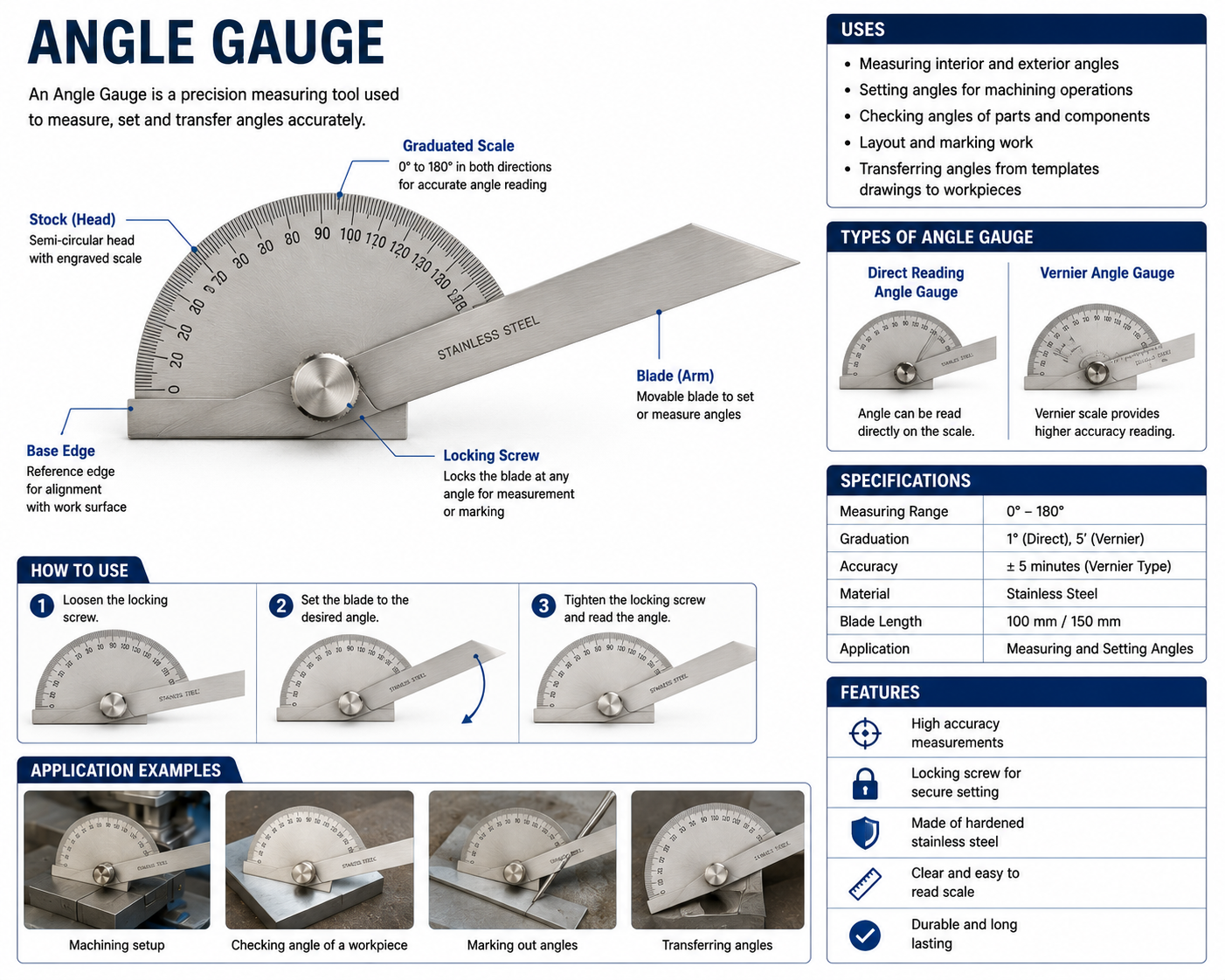
An Angle Gauge is a precision measuring instrument used to measure and set angles accurately in mechanical and fitting work. It is commonly used in workshops to check angular alignment, bevels, and machine setups. Angle gauges may be manual or digital and are essential for ensuring accuracy in machining, fabrication, and inspection tasks.
Uses
- Measuring angles of components and surfaces.
- Setting machines and tools to required angles.
- Checking bevel angles in metal work.
- Inspection of angular accuracy in parts.
- Used in fitting, machining, and fabrication work.
Parts of Angle Gauge
- Base: Provides stable support on the surface.
- Measuring Face: Contacts the workpiece for angle measurement.
- Scale or Display: Shows the measured angle.
- Adjustment Mechanism: Allows setting of desired angles.
- Locking Screw: Holds the angle in position.
Material
- Hardened steel
- Stainless steel body
- Aluminum components (in digital models)
- Electronic display (for digital gauges)
Shape
An Angle Gauge typically has a flat base with a measuring arm or face attached. It may be rectangular or circular in design depending on the type. Digital angle gauges are compact with a display screen, while manual gauges have engraved scales for reading angles.
Safety Precautions
- Handle the instrument carefully to maintain accuracy.
- Keep the gauge clean and free from dust.
- Avoid dropping or applying excessive force.
- Store in a protective case after use.
- Calibrate regularly for accurate readings.
Conclusion
The Angle Gauge is an important measuring instrument used for precise angular measurements in workshop and industrial applications. It ensures accuracy in machining and fitting operations, contributing to high-quality work and proper alignment.