

Digital Depth Gauge
Description
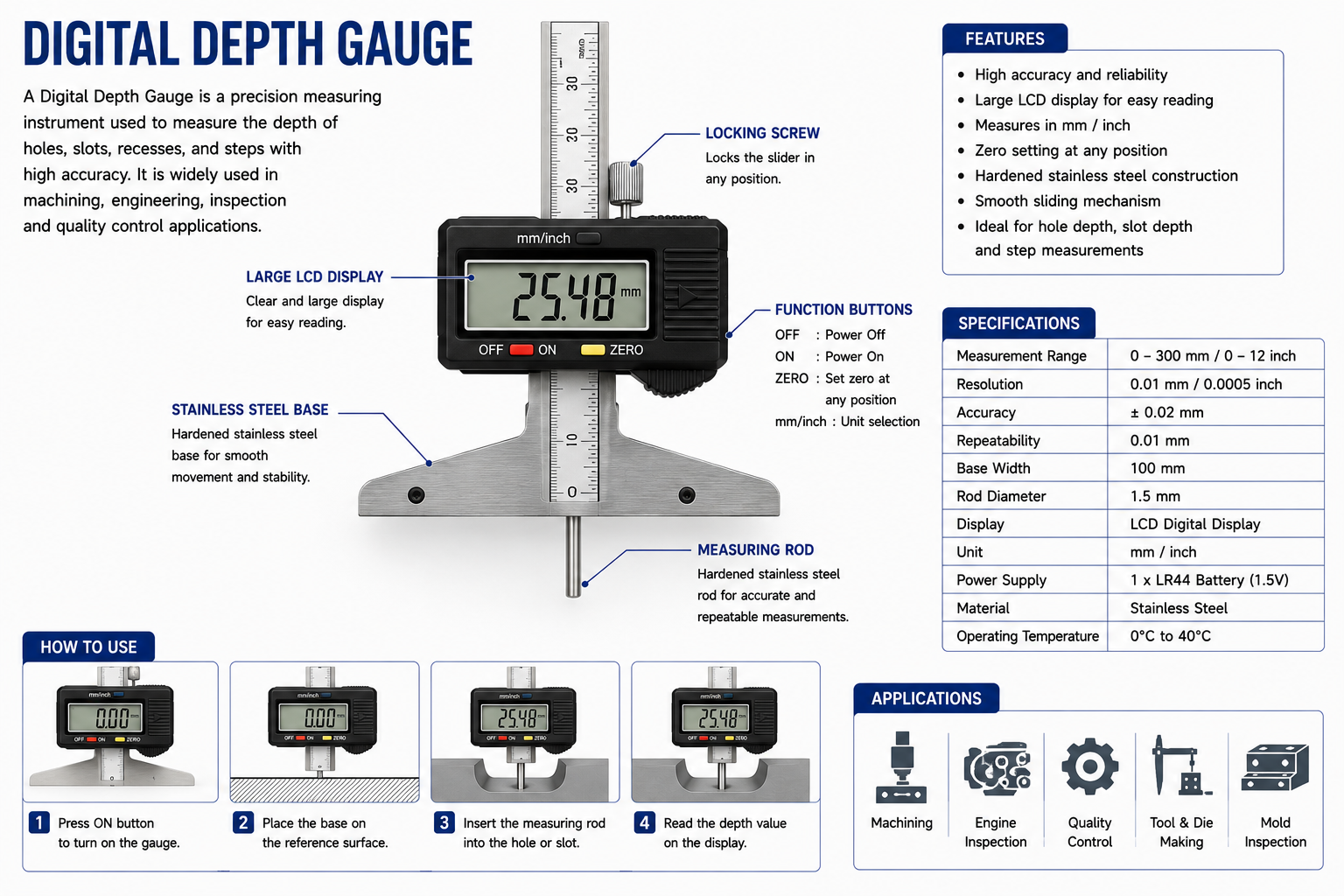
A digital depth gauge is a precision measuring instrument used to measure the depth of holes, slots, grooves, and recesses with high accuracy. It features an electronic display that provides clear and instant readings, eliminating the need for manual scale interpretation. This tool is widely used in workshops, machining, and inspection applications for quick and reliable depth measurement.
Uses
- Measuring depth of holes and slots.
- Checking groove and recess dimensions.
- Used in machining and inspection work.
- Ensuring accuracy in component fitting.
- Suitable for quality control applications.
Parts
- Base or measuring surface
- Measuring rod or probe
- Digital display unit
- Control buttons (on/off, zero, hold)
- Slider or carriage
- Battery compartment
Material
- Stainless steel measuring components
- Durable plastic casing for display
- Electronic circuitry and sensors
- Precision machined parts
Working Principle
The digital depth gauge works on the principle of electronic linear measurement. As the measuring rod moves relative to the base, a sensor detects the displacement and converts it into an electrical signal. This signal is processed and displayed as a digital reading, providing accurate depth measurement. The instrument can be zeroed at any reference point for relative measurements.
Advantages
- Provides accurate and instant digital readings
- Easy to use with clear display
- Reduces human error in measurement
- Portable and lightweight
- Suitable for various depth measurement tasks
- Quick zero-setting for relative measurements
Safety Precautions
- Handle carefully to avoid damage to the probe.
- Keep the instrument clean and free from dust.
- Avoid dropping or applying excessive force.
- Ensure proper battery condition for accurate readings.
- Store in a protective case when not in use.
- Calibrate periodically for precision.
Conclusion
The digital depth gauge is an essential measuring instrument for precise and efficient depth measurement in engineering and workshop applications. Its digital accuracy, ease of use, and reliability make it highly valuable for inspection and quality control. Proper care and maintenance ensure long-lasting performance and accuracy.