

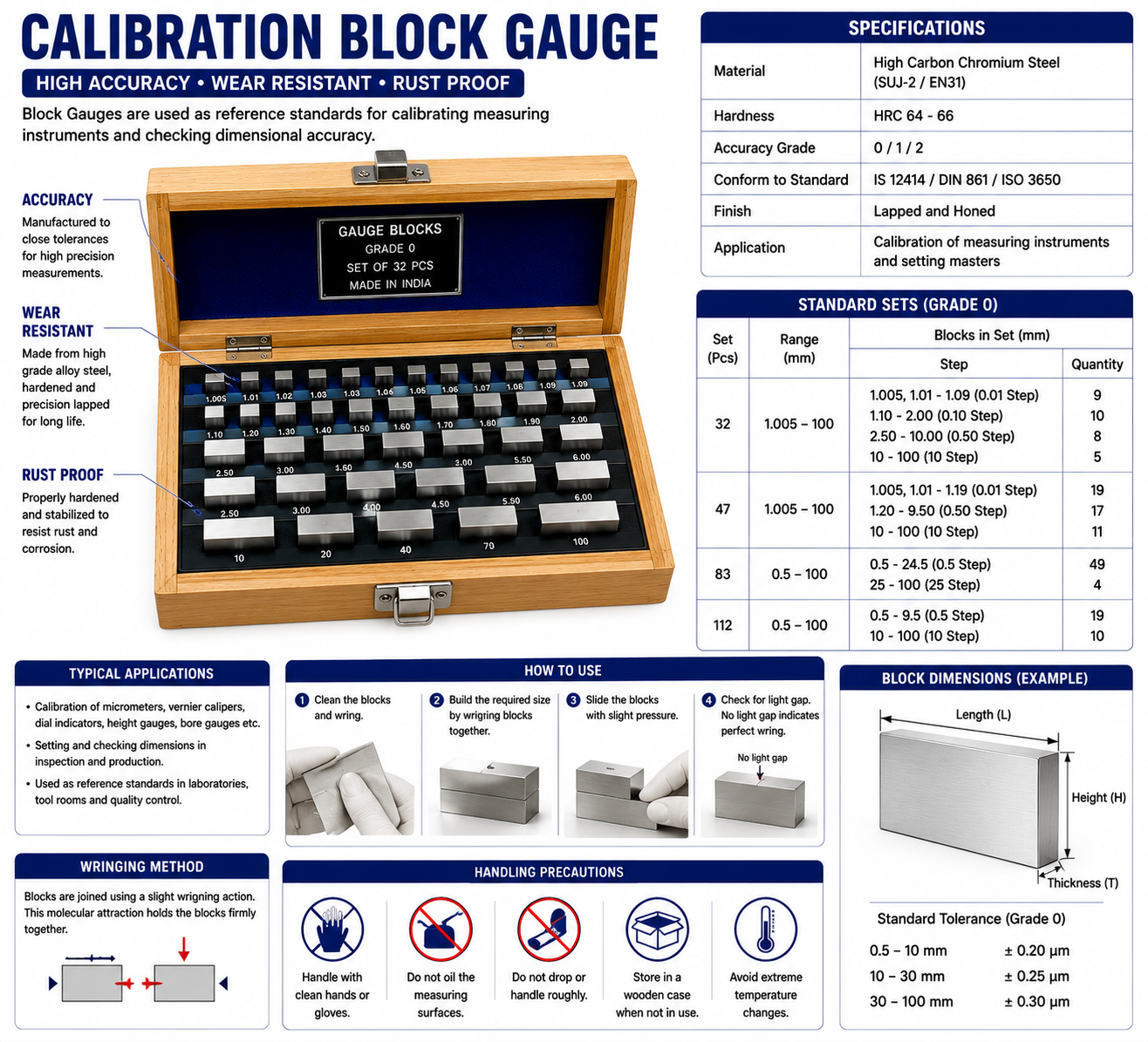
Calibration Block Gauge
Description
A Calibration Block Gauge is a precision instrument used to verify and calibrate measuring tools such as micrometers, vernier calipers, and gauges. It consists of accurately machined blocks with known dimensions that serve as reference standards. These gauges are widely used in workshops and quality control laboratories to maintain measurement accuracy.
Uses
- Calibrating measuring instruments.
- Checking accuracy of micrometers and calipers.
- Maintaining precision in measurement tools.
- Used in quality control and inspection work.
- Ensuring standard measurement practices.
Parts of Calibration Block Gauge
- Gauge Blocks: Precisely machined blocks of known sizes.
- Protective Case: Stores and protects the blocks.
- Identification Markings: Indicates size and tolerance.
Material
- Hardened steel
- Ceramic or tungsten carbide (in advanced sets)
- Precision ground surfaces
Shape
Calibration Block Gauges are rectangular blocks with flat, parallel surfaces finished to a high degree of accuracy. They are available in sets of different sizes and are stored in a protective case.
Safety Precautions
- Handle carefully to avoid damage.
- Keep surfaces clean and free from dust.
- Avoid dropping or scratching the blocks.
- Store properly in the case after use.
- Use in controlled environments for accuracy.
Conclusion
The Calibration Block Gauge is an essential precision instrument for maintaining accuracy in measurement tools. It plays a vital role in quality control and ensures reliable measurement standards in workshops and industries.