

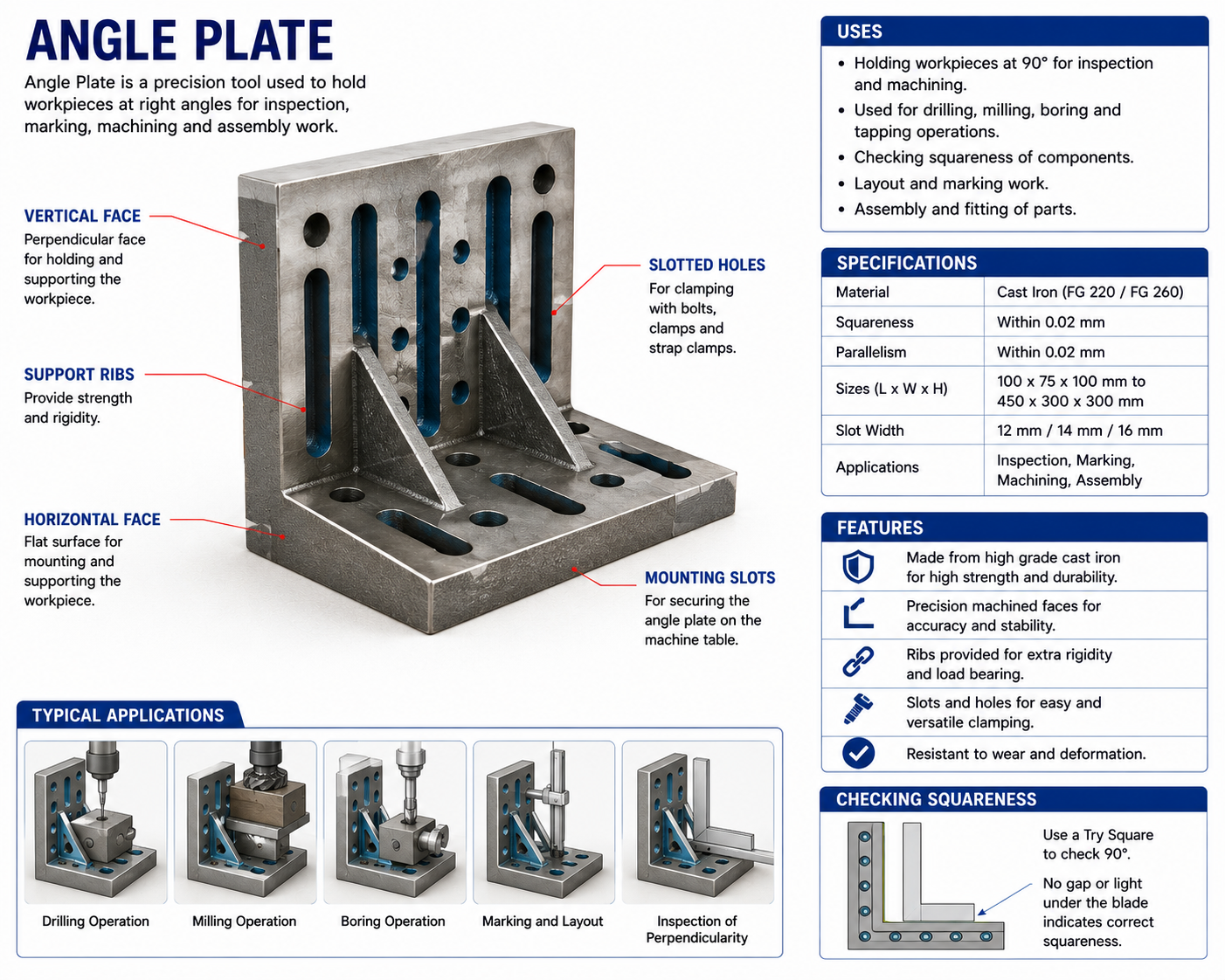
Angle Plate
Description
An Angle Plate is a precision inspection and holding tool used to support and position workpieces at a right angle (90°) during machining and inspection operations. It is commonly used in fitting, drilling, and milling work to ensure accurate alignment. Angle plates are designed with high accuracy and rigidity, making them essential in workshops and tool rooms.
Uses
- Holding workpieces at right angles during machining.
- Supporting components for drilling and milling operations.
- Checking squareness and alignment of parts.
- Used in inspection and precision fitting work.
- Providing stable support for marking and layout work.
Parts of Angle Plate
- Base: Provides stable support on the machine table.
- Vertical Face: Holds the workpiece at 90° angle.
- Slots or Holes: Used for clamping the workpiece.
- Ribs: Strengthen the structure and maintain rigidity.
Material
- Cast iron
- Hardened steel (in some precision models)
- Ground and machined surfaces for accuracy
Shape
An Angle Plate has an L-shaped structure with two flat surfaces positioned at a right angle to each other. The base rests on the machine table, while the vertical face supports the workpiece. Slots or holes are provided for clamping purposes.
Safety Precautions
- Ensure proper clamping of the workpiece.
- Place the angle plate on a clean and flat surface.
- Avoid dropping or striking the tool.
- Keep surfaces free from dirt and burrs.
- Handle with care to maintain accuracy.
Conclusion
The Angle Plate is an essential precision instrument used in machining and inspection work. It ensures accurate positioning and alignment of components, making it a valuable tool in workshops and industrial applications.